City Futures Blog

News and research in housing and urban policy, from Australia’s leading urban policy research centre.

City Futures Blog random header image

Projections, targets, forecasts and models: how do Sydney’s metro strategies try to anticipate our future housing needs?

Posted by on March 8th, 2016 · Government, Housing, Housing supply

By Laura Crommelin, Laurence Troy and Ray Bunker

As the planning boffins out there will know, Sydney has been the subject of three metropolitan strategies in the past decade – 2005’s City of Cities, 2010’s Plan for 2036 and 2014’s Plan for a Growing Sydney. In a recent working paper, City Futures Visiting Associate Professor Dr Raymond Bunker looked closely at these plans, teasing out what they tell us about the successes and failures of ‘compact city’ planning efforts in Sydney. One of the issues Dr Bunker explores is how these plans address the challenge of providing adequate housing for Sydney’s growing population. This blog post excerpts and expands on a few key elements of this analysis.

The 2005 Plan was the first to clearly espouse the compact city model. Various observers noted that the plan responded to strong developer lobbying (Searle 2006; Bunker 2007), as well as media and public pressure. It proposed that 70 per cent of new dwelling stock be built within the existing urban area by infill and redevelopment, with the other 30 per cent in greenfields growth. The 2005 Plan was accompanied by sub-regional strategies which developed housing targets by Local Government Area (LGA) for additional dwellings to 2031. These were informed by METRIX, an online model which examined the feasibility of locating these additional dwellings in centres as opposed to surrounding areas.

Growth following the 2005 Plan was disrupted by the GFC, the difficulties in redeveloping brownfields sites and the shortage of greenfields areas ready for development. The updated metropolitan strategy of 2010 took much the same approach, aiming to “[l]ocate at least 70% of new homes in existing suburbs and up to 30% in greenfields areas” (p. 7).

However, a change of government in 2011 led to another plan, which eschews any specific targets for greenfields and infill/renewal. Instead, the 2014 Plan concedes that some aspects of the housing market are outside government control, and focuses more on feasible development. While the plan does still contain an overarching housing target for 2031, it offers a more pragmatic perspective than the visionary long-term prognoses of the earlier plans, as “[t]he private sector will only develop housing on rezoned sites where there is sufficient consumer demand for it, at a price that provides a return to the developer” (p. 66).

Accordingly, the plan identifies areas with potential additional housing capacity, but then uses an Urban Feasibility Model to test development options for each subregion. It proposes setting five year housing targets with local councils to maximise the opportunities for growing housing supply. This is a shift from the longer-term sub-regional housing targets set under the 2005 and 2010 Plans.

So what can be gleaned from the more recent plans about how the provisions of the 2005 Plan have fared? There is little in the later plans about how the earlier targets have tracked, although there is a 2014 Property Council publication called Missing the Mark, which suggests that housing construction has failed to achieve the ambitions of the 2005 Plan.

Table 1 (below) shows the additional dwelling targets for each sub-region as derived from the 2005 Plan (p.18) and 2010 Plan (p.115). While the targets cannot be exactly compared as they are for slightly different time periods, they do show some wide variations in the additional subregional housing targets set in the two plans. The final column shows further variation in the dwelling projection figures released in 2013, which appear to have informed the total housing target of 664,000 cited in the 2014 Plan (p.65). It is important to note, however, that the 2013 figures are projections, not targets, and “do not necessarily reflect policy positions and may well differ from policy targets expressed in the Planning and Environment’s Metropolitan and Regional Strategies” (Department of Planning & Environment 2014b, n.p.).

Subregion 2005 Plan: 2004-2031 Targets 2010 Plan: 2006-2036 Targets 2013 Data: 2011-2031 Projections[1]
Central 55,000 61,000 53,700
East 20,000 23,000 32,650
South 35,000 58,000 76,500
Inner West 30,000 35,000 34,650
Lower North Shore 30,000 44,000 48,300
North 21,000 29,000 30,650
North East 17,300 29,000 26,250
West Central 95,500 96,000 102,550
North West 140,000 169,000 150,500
South West 155,000 155,000 108,550
Total 598,800 699,000 664,300

Table 1: Additional dwelling targets by sub-region in 2005 & 2010 Plans; dwelling projections by sub-region in 2013 Data


To explore this data further, a detailed table in the working paper breaks down the 2005 targets and the 2013 projections by LGA, and provides annualised figures to address the different time periods covered (see Table 2 on Page 8 of the working paper). While still an imperfect comparison, the juxtaposition of these two sets of housing figures raises important questions about the relationship between the setting of housing targets and the actual operation of the private sector in delivering new dwellings, while emphasising the growing dwelling needs to 2031.

For a more blog-friendly representation of the data set out in Table 2, CF Research Associate Dr Laurence Troy has developed interactive maps showing these annualised 2005 and 2013 figures, and the percentage difference between them. Click on specific LGAs in the maps to see the exact numbers. Obviously, the same disclaimers about comparability also apply to these maps, but they nonetheless tell an intriguing story about the shifting development expectations for various parts of Sydney over the past decade.

The first map, which shows the 2005 Plan housing targets, places much of the emphasis on delivering new dwellings in the two major growth centres in Western Sydney. The expectation in this strategy was that the inner west, eastern suburbs and lower north shore would have a much smaller role in delivering on housing targets. The City of Sydney is the exception, largely driven by the impacts of major developments in Green Square.

The second map, showing the 2013 projections, maintains the level of dwellings in the Western Sydney growth areas, but also increases the contributions expected of inner areas.

The final map (at the top of this post, and below) shows the percentage change in dwelling targets across the two plans, and suggests a renewed emphasis on inner zones, from the inner west through to Sutherland. It is particularly interesting to note the decline in dwelling targets from already low values in Strathfield and Burwood, despite both areas being part of the Parramatta Road corridor, which is the focus of major strategic planning in connection with the WestConnex road project.

Ultimately, however, perhaps the most interesting story here is the complexity involved in collating and comparing housing figures across the different plans. This highlights the need for more adequate explanation of what housing targets, projections and forecasts mean in various planning documents, and how they relate to one another. This complexity also demonstrates the drawbacks of Sydney’s planning landscape, which has been shaped by a lack of continuity and strong influence by various interest and lobby groups. On this point it is useful to compare the situation in Perth, where a centralised planning agency with bi-partisan support has been in place for decades. The planning outcomes are quite different, and will be explored in a forthcoming working paper by Dr Bunker, due out in early March. Be sure to check back here for its release.

Notes:

[1] These projections were released by LGA; they have been aggregated here in line with the sub-regional structure used in the 2005 and 2010 Plans. The original data is available at: http://www.planning.nsw.gov.au/projections.

Would negative gearing reform push up rents?

Posted by on March 3rd, 2016 · Affordability, Government

9105470941_ae9d3127c0_z

Modeller to the property industry, BIS Shrapnel, reckons reforming negative gearing would increase rents by 4-10 per cent. Is that right?

First, always keep in mind that when property interests ‘warn’ about rent increases, you should suspect an ulterior motive. Landlords  and their representatives aren’t worried about or afraid of rent increases – they love them! It’s more money for them – that’s why they increase rents whenever they think the market will bear it.

No landlord has ever accepted less than the going rent just so that they can be negatively geared. Instead, if they find that the going rent is more than their liabilities (interest, etc), the dedicated gearer will go back to the bank, borrow more money and buy more property.

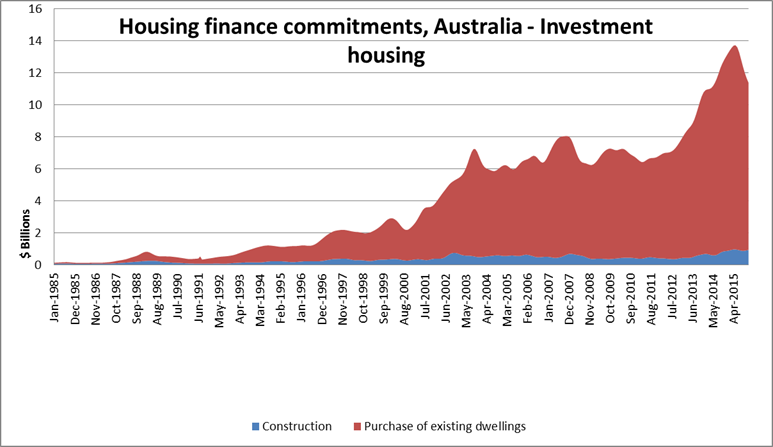
Which brings us to a second point. Negative gearing doesn’t cause landlords individually to lower their rents, and it doesn’t really help bring on additional supply that might push rents down across the market. It has been the case for a long time that the money  ‘investors’ borrow to spend on property goes overwhelmingly into existing properties.

Copy of 5609011_13077_image002

(ABS 5609.0 – Housing Finance, Australia, Dec 2015, table 9)

These purchases are of properties either already rented, or that would otherwise be owner-occupied – either way, there’s no net addition to rental housing supply.

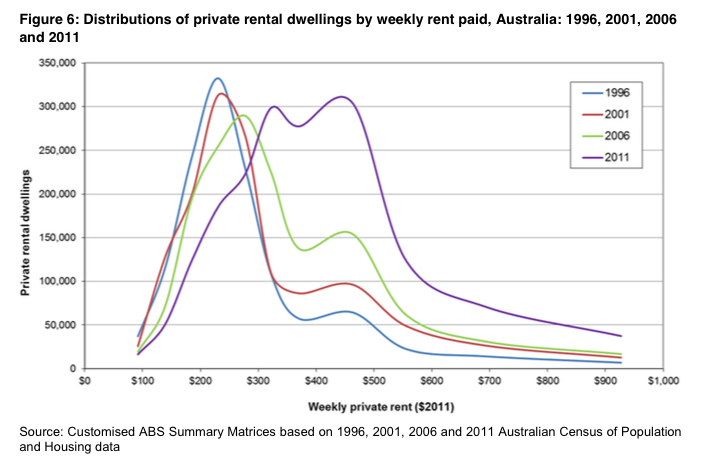
What these purchases have done, however, is change the shape of the rental market – both in terms of the stock on the market, and the people renting it. That’s because ‘investors’ have been making  speculative purchases of higher value properties that can be sold later to another speculator or owner-occupier with money to throw at property; at the same time, more higher income households, priced out of owner-occupation, are renting and out-competing lower income households for the relatively scarce affordable rentals.

Screen+Shot+2014-12-11+at+10.39.09+am

(Hulse, Reynolds, Stone and Yates (2015))

So, as one of the factors that has fanned speculation in housing, negative gearing has helped push rents up, particularly for low-income households. And reforming negative gearing, along the lines recently proposed by Labor, to dampen speculation and direct investment to new supply, should help reshape the rental market into one that more reflects the demand for rental housing by households across the range of incomes, than punts on what will attract a premium from subsequent geared-up purchasers.

But… could rents rise as an immediate response to negative gearing reform?

The experience of the short-lived 1985-87 reform of negative gearing doesn’t support this, as rents went down, up and sideways, depending on the city, over that period.

When it comes to the present proposal, existing investors would be grandfathered, so their costs will not rise upon implementation of the reform. Even so, the prospect of capital gain will decline, so some of them might exit the market – but they won’t wind up (destroy) their property, they’ll sell it. If they sell, it will either be to another investor – so no reduction of supply – or into the owner-occupied sector, thus making room for a renter to leave the rental sector – so no net reduction of supply.

New negatively geared investors in existing housing coming after the reform would face relatively higher costs (as the part of their non-rental income consumed by the net cost of their investment would be taxable), and they may want to push that cost onto tenants. However, most of that cost, being interest, is not avoidable by having no tenant, so that should discourage them from holding out unduly for a higher rent that covers the cost, especially as the market would also include grandfathered investors and new investors in new stock.

Nonetheless, it is true that tenants don’t have the same degree of power as do most other consumers, because so many of those looking for rental housing need it urgently (you cannot go without a house for long) and because once in a house it is difficult to shop around (moving is financially and emotionally costly). It is possible that this structural imbalance in the individual landlord-tenant relationship could be exploited by landlords who, while ordinarily in competition to meet the market and fill vacant properties, may as a group feel that the scare stories around the supposed impact of negative gearing reform give sufficient cover for a concerted grab at a greater share of the national income.

If that happened, it would be an abuse. If there is genuine concern that a reform of negative gearing may be the occasion for an abuse of this kind, governments could guard against it by legislating for a temporary cap on rent increases while reform is implemented. Let’s see the property lobby get behind that.


Climate Change Adaptation for Settlements and Infrastructure

Posted by on February 25th, 2016 · Climate change, Government

Visualisation of a current climate 100 year flood event in Southeast Queensland

(Visualisation of a current climate 100 year flood event in southeast Queensland)

The Australian Climate Change Adaptation Research Network for Settlements and Infrastructure (ACCARNSI) Forum and Workshop was held 15 – 17, February 2016 on the Campus of the University of Canberra, ACT. ACCARNSI is one of four National Climate Change Adaptation Research Facility (NCCARF) hosted adaptation research networks. The goal of the event was to provide an opportunity for researchers and practitioners in engineering, urban planning, built environment, and social sciences to meet and share their work and observations on climate change adaptation research in Australia. Workshop participants included early career researchers and practitioners from Queensland, New South Wales, the Australian Capital Territory, South Australia and Tasmania as well as academics with long standing NCCARF connections from the University of Canberra, the University of New South Wales and Griffith University.

City Futures Research Centre’s focus on city shaping, housing, change, well-being and analytics can potentially add value to the settlements and infrastructure focus of ACCARNSI. Topics of the early career researcher and practitioner presentations included community understandings of place, integrated land-use and transportation modelling, climate migration, sustainable development, climate impacts on agriculture, building facades and outdoor microclimates, urban vegetation, the performance of urban green infrastructure, financing models for coastal protection, climate impacts on stormwater infrastructure, tourism and local government’s role in climate change adaptation.

My goal for the workshop was to present research on the use of geographic visualization as a tool for information exchange about climate impacts. The specific aim of this research is to test methods and evaluate the effectiveness of geographic information-based tools to communicate information. Initial results show that the multiple visual methods tested for communicating climate information were effective, but 3D visualization was the most effective method for knowledge exchange. The research speaks to the use of spatial decision support systems and spatial planning more broadly to be able to help coastal communities confront the combined effects of climate change: flooding, sea level rise, storm surge, and severe weather events. Preliminary publications emerging from this research are available from the Australian Journal of Maritime & Ocean Affairs and in the edited volume Planning Support Systems and Smart Cities.

Themes that emerged over the three days of presentations and discussions include the roles of different levels of government and cross-boundary governance issues in climate adaptation. Numerous presentations touched upon the use of Intergovernmental Panel on Climate Change (IPCC) scenarios and time horizons on perceptions of threat. It was consistently found that long time frames diminish perceptions of threat. From a local government perspective, it was agreed what’s needed are projected climate data linked to specific near term time frames.

Workshop overviews are also available from the University of Canberra Institute for Governance and Policy Analysis as well as University of Canberra Media & Communications.

Tax reform for affordable housing: Labor’s negative gearing and capital gains tax proposals

Posted by on February 18th, 2016 · Affordability, Construction, Housing

4782904694_4acae66d7e_z

By proposing to restrict negative gearing to new-built housing and reduce the tax discount for capital gains, Federal Labor has presented a real policy platform for more affordable housing.

The high cost of housing in Australia – to buy, and to rent – is largely a product of our current tax settings, which favour highly-geared speculation in existing houses. At the Federal level there are, in particular, three tax settings that link together to have this effect. [Read more →]

Tenancy law reform for ‘secure occupancy’

Posted by on February 8th, 2016 · Government, Law, Tenancy

16529280858_ed84fc86d6_z

New South Wales tenancy laws are under review, and City Futures has made a submission drawing on our research into how well Australia and other countries provide for ‘secure occupancy’ in rental housing.

The research, conducted in collaboration with Swinburne University for AHURI, sought to capture the extent to which households in rental housing can make a home and stay there for reasonable periods, provided they meet their tenancy obligations. [Read more →]

More questions than answers in NSW ‘strategic housing’ announcement

Posted by on January 26th, 2016 · Government, Housing supply, Uncategorized

By Hal Pawson and Vivienne Milligan

Future directions logo

Finally, the long wait is over. Five years after taking office the State Government’s Family and Community Services Department (FACS) has at last pronounced on ‘Future Directions for Social Housing in NSW’. All of the paper’s broad themes – modernisation, additional supply and supporting tenants – will resonate with the affordable housing industry. But despite numerous evidence-based policy pledges on proposed micro-measures, none of the State’s overarching affordable housing and support needs are quantified and none of the solutions clearly costed. [Read more →]

Hopes of a new urban age survive minister’s fall

Posted by on January 20th, 2016 · Cities, Government, Guest appearance

21702784243_218f1cc964_z

By Robert Freestone, Professor of Planning, Faculty of Built Environment, UNSW. Originially published at The Conversation.

The resignation of Australia’s first minister for cities and the built environment after just 99 days is a setback for federal leadership in these areas. Yet enough momentum and goodwill have been generated to keep the flag flying. The greatest hope is that an urban consciousness in national public policy will be lodged permanently. [Read more →]

Housing is overpriced because it is undertaxed

Posted by on January 14th, 2016 · Affordability, Housing

5223313488_e366f3e9b1_z

The Australia Institute is in the media this week with a proposal to tax capital gains on high-end owner-occupied housing. They’ve backed the call with modelling that shows the current exemption of owner-occupied housing (all owner-occupied housing, not just the high-end stuff) benefits high-income households the most: of the $46 billion in tax revenue foregone this year because of the exemption, more than half of it is kept by the top 20 per cent of households by income, with more than one third kept by the top 10 per cent. Under the Australia Institute’s proposal, rolling back the exemption from properties sold at more than $2 million would affect just one per cent of properties, but raise almost $12 billion in tax over the coming four years, mostly from the top 20 per cent of earners.

The Institute presents its case primarily in terms of ‘budget repair’ and encouragement of productive investment. For some reason it buries what is the best argument for rolling back the CGT exemption: it would help make housing more affordable (this gets just a single mention in their paper). Housing is overpriced because it is undertaxed. [Read more →]

Are we seeing a new dawn for affordable housing?

Posted by on December 17th, 2015 · Government

15087147211_5fbd51f1a5_z

By Hal Pawson and Vivienne Milligan. Originally published at The Conversation.

Potentially trailblazing plans for state-assisted financing of affordable housing are emerging in New South Wales. In what looks to be a landmark policy announcement with possible national ramifications, the NSW government last week outlined the first phase of Premier Mike Baird’s March 2015 election commitment to establish a A$1 billion fund for social and affordable housing.

But for the short-lived GFC housing stimulus, this is the first significant rental housing supply subsidy in Australia since the 2008 National Rental Affordability Scheme (NRAS).

While full details are yet to be disclosed, it appears the Social and Affordable Housing Fund (SAHF) will be something like a “future fund” or endowment scheme. Government will invest a capital sum in revenue-generating assets. The resulting returns will underpin annual payments to approved consortia over 25-year terms.

This ongoing subsidy will help community housing providers bridge the gap between rental revenue and operating costs. Most importantly, it includes repayment of construction debt raised from private financial institutions such as banks and super funds. Perhaps in awareness of research evidence on ways to minimise the cost to taxpayers of private finance for affordable housing, officials acknowledged the possibility of a government guarantee or other credit support on loans to consortia.

In principle this is quite a big deal. The more familiar policymaking style involves one-off or pilot initiatives. The SAHF is presented as an ongoing budget commitment to state-supported social and affordable housing growth, with phases two, three and four of the program signalled at the launch.

Second, as the name implies, SAHF is centred on “social” housing: it has a 70% minimum social housing requirement. Unlike schemes such as the NRAS, most of the homes will be financed to allow rents set at levels manageable for very low-income groups rather than affordable only to moderate-income earners.

In the post-GFC world this is highly unusual. For example, only in Scotland does a significant UK social housing investment program remain intact.

Third, and most important, the fund’s creation reflects a long-overdue official recognition that, left to itself, the market does not and cannot provide decent housing that low-income groups can afford.

Big plans, but starting small

While potentially important in principle, the SAHF is decidedly modest in practice, at least in its initial phase. The statewide target – implicitly to be achieved over several years – is for just 3,000 homes. This will barely scratch, let alone seriously dent, the backlog of 60,000 applicants marooned on the NSW public housing waiting list.

And that’s before you even consider the tens of thousands of unregistered low-income private tenants pushed into poverty by high rents across the state. In Sydney alone, 94,000 families and single people were in this position in 2011. Many if not most will be additional to those on the public housing list.

Nevertheless, there’s a lot to like in the NSW government’s approach. It puts non-profit community housing providers (CHPs), which have a strong track record of high-quality tenancy management, front and centre. Registered CHPs will manage all SAHF housing.

The scheme offers a long-term (up to 25 years) operating subsidy that can be matched to a private financing deal. This gives private investors like super funds the certainty they need. “We’ve listened and we’ve read the reports on that,” officials said.

And it recognises the cost to social landlords of co-ordinating services for tenants who have support needs: the operating subsidy will include a component for this. The 2010 Henry review of taxation recommended this.

Limits to affordable land must be overcome

Having access to land at an affordable price is fundamental to successful affordable housing strategies. Phase one of the SAHF relies on unlocking land to develop social housing owned by churches, NGOs and other philanthropic sources. This is a finite strategy and we query whether well-located sites for 3,000 dwellings will be forthcoming? What then?

The state government has the two-part answer in its power. First, it must require all medium- and large-scale residential projects to include a reasonable component of affordable housing. For Sydney, we suggest a city-wide target in the region of 15-25%.

There is a once-in-a-generation opportunity right now in Sydney to do this as large-scale redevelopment plans unfold along transport corridors, in precincts and renewal areas. Once developers have bought up that land it will be too late. They need to be able to factor into their feasibility plans the cost of providing the affordable housing, and thereby reduce the price they offer for sites.

Second, state and local government-owned land made available for affordable housing (for example, public housing estates slated for renewal, surplus government sites and air spaces above public sites) must be priced at a level that affordable housing developers can afford to pay to keep their costs (and therefore the government operating subsidy exposure) to a minimum.

Only by linking its financing strategy with favourable pricing of state land offers and planning policy changes will the SAHF be scalable and durable – offering potential to reduce the unacceptably high levels of unmet housing need.

Premier Baird is expected to announce further details of the fund early in the new year. With worsening affordable housing shortages around the country, it must be hoped that the prime minister, his treasurer and his cities minister, as well as premiers and treasurers across Australia, will tune in to learn more on this constructive initiative.

Prof Susan Thompson awarded Sidney Luker Medal

Posted by on December 14th, 2015 · Wellbeing

Congratulations from everyone at City Futures to our colleague Professor Susan Thompson, who has been awarded the Sidney Luker Medal by the Planning Institute of Australia.

P1130032a

Susan’s work is all about healthy planning. In her acceptance speech for the award (extracted below), she looked back on where her work has come from, and where it may be headed. [Read more →]