Steven Derne’s Globalization on the Ground Media and the Transformation of Culture,Class and Gender in India
– A Review by Julien Cayla
Beyond the hype about a great Indian middle class, the image of English-speakingIndians working in call centers and software companies, we need more nuanced accounts that critically examine the shift to neoliberal market economy in India. Steve Derné’s ethnographic work on film viewing in India is an important step in that direction. Derné offers a valuable perspective on the changes that have happened in India over the last fifteen years.
Derné argues that while globalization has intensified the Indian elite’s obsession with the West, it has not dramatically impacted what he calls the locally oriented middle class,the laborers, drivers and clerks which form the bulk of the Indian middle-class. As the author acutely observes “we must always keep in mind that the effects of globalization are mediated by class.” (p. 128).
Grounding his arguments in his longitudinal work with male film viewers in Dehra Dun, a mid-size town in North India, Derné is able to trace the continuity in film viewers’ understandings of family arrangements, the rejection of love marriages, female modesty, and the association of Western women’s fashion with unacceptable sexuality. He makes an especially important distinction between a “locally-oriented” middle class which remains attached to traditional family arrangements and a transnational Indian middle class which positions itself transnationally, in relation to the Western middle class. Furthermore, Derné argues that material conditions (such as middle class Indian women’s access to better jobs) will have to significantly change for middle-class Indians to start embracing the types of values and lifestyles depicted inWestern media forms.
This distinction between a locally oriented middle class and a transnationally oriented segment of the population is well-needed. Despite all the talk about the changing lifestyles of the “great Indian middle class” (see Varma 1998), Derné is able to show that for most of the Indians he met in 1991 and then 2001, life has not dramatically changed. Some of these men may have access to slightly better jobs but by and large,their conceptions of love marriages as fantasies and women’s commitment to family duties, their notions of family, gender and modernity have remained very similar. For the locally-oriented middle class, Derné argues, Hollywood films and other forms of transnational media have even intensified notions of male dominance and the objectification of women through images of male strength and female weakness.
In contrast, for the 5% of Indians who speak English well, the globalization of the Indian market has meant access to well-paid jobs and cosmopolitan lifestyles. While foreign travel, consumption of global brands and love marriages remain alien to most Indians, members of the Indian elite have more easily embraced these values and behaviors. Derné’s argument is that we have overstated the cultural change happening in India, that because structural and institutional arrangements haven’t dramatically changed for most ordinary middle-class Indians, their social imaginary is bound to remain very similar towhat it was a decade ago.
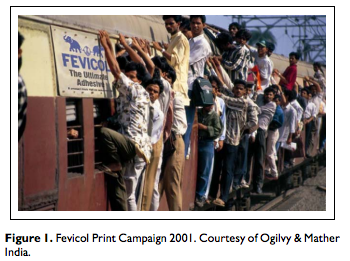
While Globalization on the Ground is an important and original ethnography, there is a crucial element that is missing from Derné’s analysis: the nation. While Derné’s depiction of a Westernized transnational affluent class rings true in some respects, one has to analyze these links to transnational circuits of consumption and labor in relation to the nation. One only has to look at the advertising efforts of foreign multinationals like De Beers, Cadbury or Procter and Gamble in India to realize that, rather than promotingWestern lifestyles, both foreign and local companies have intensified images and talkof Indian tradition and what it means to be Indian. When Derné analyzes the evolutionof Bajaj’s advertisements, he misses those nationalist undertones completely. For if the Ghandian man of earlier Bajaj ads has almost disappeared, Bajaj advertisements still talked until recently of national identity and national values (see Shatrujeet 2001). If globalization has reinforced the economic divide amongst Indians, nationalist discourses have permeated Indian public culture (Mankekar 1999; Rajagopal 2001). We can regret that Derné did not engage with this critical aspect of Indian public culture.
In addition, one can only regret that in his ethnographic work, he did not use the rapport he developed with his informants to better understand their own ideas about the opening of the Indian economy, their ideas of the West, their ideas about globalization. A better understanding of globalization and capitalism will have to start with such engagement.
Finally, by equating globalization with “transnational messages” (p. 163) and “transnational media” (p. 30), Derné has oversimplified the mechanisms of global capitalism. It did not take very long for MTV to Indianize their programming (see Butcher 2001). Associating MTV or the arrival of cable television with globalization is in some ways similar to the homogenization theory Derné tries to dispel. It equates globalization with a sort of wave of foreign and Western material which depicts alien ways of life. In doing so, Derné misses the complexity of global capitalism.
References
Butcher, Melissa (2003), Transnational Television, Cultural Identity and Change: WhenSTAR Came to India. Sage Publications.
Derné, Steve (2008). Globalization on the Ground: Media and the Transformation ofCulture, Class and Gender in India. Sage: New Delhi.
Mankekar, Purnima (1999), Screening Culture, Viewing Politics: An Ethnography ofTelevision, Womanhood and Nation in Postcolonial India. Durham, NC: Duke UniversityPress.
Rajagopal, Arvind ( 2001), Politics After Television: Hindu Nationalism and theReshaping of the Public in India. Cambridge: Cambridge University Press.
Shatrujeet, N. (2001), “Lintas Renews Tryst with Hamaara Bajaj anthem,” http://www.afaqs.com/perl/media/index.html?sid=3308 [accessed January 20 2008].
Varma, Pavan (1998), The Great Indian Middle Class. New Delhi: Viking.